

Part 1 of 4: Walking In The Spirit
Morning Steward (Observations)
This story was born out of lived experience.
For many years I navigated health challenges through prayer, observation, and my relationship with Jesus Christ. As various issues within my body were addressed, I began noticing something I had never seen before. There were patterns operating within me that no longer belonged to my present circumstances, yet they continued influencing my daily life.
When I retired, I discovered that although the workplace had disappeared, the systems created by years of stress, pressure, deadlines, conflict, and constant responsibility had not disappeared with it. The environment was gone, but its imprint remained.
My body was no longer going to work, but parts of my being were still responding as though the demands of work were present. Stress patterns continued unfolding. Tension continued appearing. Vigilance continued operating. These patterns interrupted peace, disturbed rest, and quietly drained life from experiences that should have been enjoyable.
What became clear is that retirement did not automatically restore health.
- The environment changed.
- The internal patterns remained.
As Christ continued restoring my health, I began learning how to move with my body rather than against it. I learned to pay attention to what was happening within me. I began spending more time outside. I removed electronics from my sleeping environment. I changed my relationship with food and made restoration a priority. Instead of forcing change, I became interested in observing what my body was revealing.
Out of that journey came the practice I call Morning Steward.
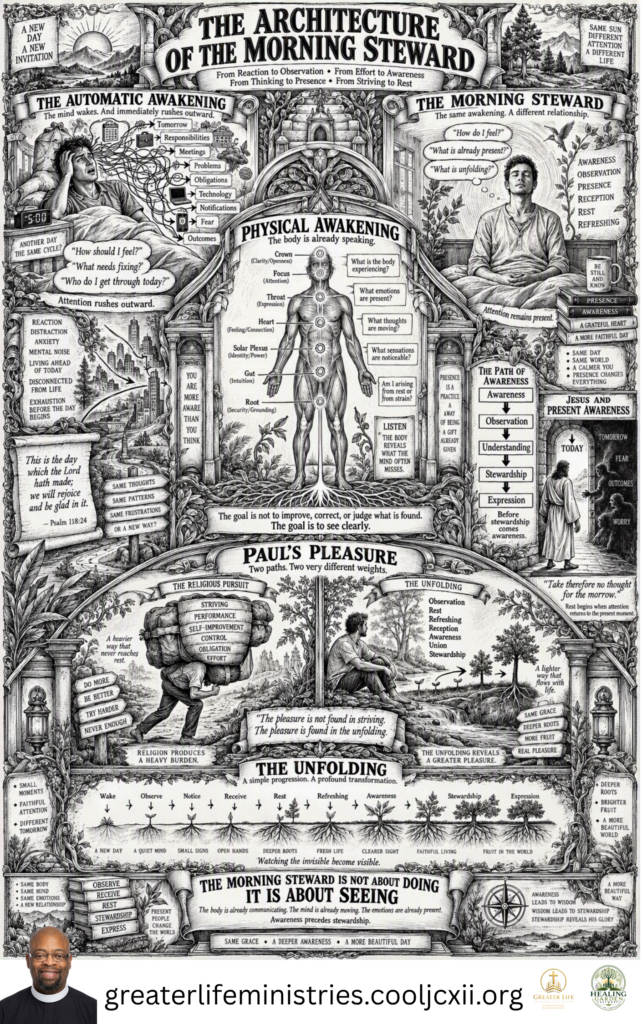
Morning Steward is what happens first. In this space your role is centered on observation rather than the normal activities and events you participate in daily. It does not begin because a clock says it is time to begin, it starts when you wake up or when awareness returns upon waking.
The purpose of the Morning Steward is to establish awareness before activity. Before there are meetings, projects, responsibilities, ministry assignments, or other people requiring attention, there is an opportunity to notice what is already occurring within.
The moment you enter your body, it is already communicating. The mind is already moving, and emotions are already present. The practice of the Morning Steward is not to change these things but to become aware of them before thought, interpretation, analysis, and automatic reactions begin shaping the day. It is a return to observation. A return to listening. A return to sensing what is present before attempting to manage, correct, improve, or direct it.
Alignment is especially important at the beginning of the day because it is easy to become occupied with experiences that do not yet exist. A person can awaken in the present moment yet already be carrying tomorrow’s concerns, future outcomes, imagined conversations, unfinished responsibilities, and anticipated problems. In doing so, attention leaves what is actually present and becomes invested in what is only being projected.
Before there are meetings, projects, responsibilities, ministry assignments, or other people requiring attention, there is an opportunity to notice what is already occurring within. The Morning Steward protects that opportunity, allowing awareness to establish itself before the interpreter begins constructing meanings, scenarios, fears, and obligations from things that have not yet happened.
Throughout the day attention is continually drawn outward toward problems, responsibilities, conversations, ministry work, technology, and decision-making. The Morning Steward reverses that pattern. Before engaging the world, attention is directed toward inward observation.
Without observation, the other roles eventually begin operating from habit, pressure, reaction, and duty instead of awareness. The Morning Steward is therefore not about accomplishing something. It is about becoming aware of what is already present.
Physical Awakening: How I awake is just as important to how I get to sleep.
Most people awaken and immediately begin thinking about the day ahead. Attention rushes outward toward responsibilities, meetings, problems, obligations, plans, and unfinished tasks. Before any of that occurs, there is an opportunity to observe what is already present.
The purpose of Physical Awakening is not to change anything that is happening internally. The purpose is observation.
- What is the body experiencing?
- What is the quality of attention?
- What emotions are present?
- What thoughts are already moving?
- What sensations are noticeable?
The goal is not to improve, correct, or judge what is found. The goal is to see clearly. Physical Awakening is the practice of meeting the day honestly before attempting to manage it, setting aside comparison, analysis, and the need to become something other than what is presently being experienced.
Observation does not ask, “How should I feel?” It asks, “How do I feel?” Many approaches encourage replacing a present experience with a preferred one, but observation begins by being honest with what is actually present. By sensing what is occurring within, a person begins to recognize the source from which they are operating. Am I arising from rest or from strain? Am I settled or already carrying tension? This awareness is not for judgment but for understanding. It reveals whether the inner man is moving from rest or from effort, from peace or from agitation. Before stewardship comes awareness, and before awareness comes honest observation.
Jesus Christ’s rest requires this practice because He Himself describes it in simple terms: “Take therefore no thought for the morrow: for the morrow shall take thought for the things of itself” (Matthew 6:34). The invitation is not to ignore responsibilities, but to refrain from leaving the present moment in order to live mentally in a future that does not yet exist. Observation helps reveal when this is happening. A person may awaken physically in the present yet discover that their attention is already occupied by tomorrow’s problems, obligations, fears, and outcomes.
The moment this is seen, they also begin to see the source from which they are operating. Rest is not achieved by forcing peace upon the mind. Rest begins by becoming aware of where attention has gone and gently returning it to what is present now. In this way, observation becomes a practical expression of rest, allowing a person to meet the day as it is rather than as it is imagined to be.
Many people spend years trying to escape their present experience without ever becoming aware of it. As a result, they react to internal states they never learned to observe.
The Morning Steward takes a different approach. Before changing anything, notice. Before correcting anything, observe. Before attempting to move the body, calm the mind, organize the day, or solve a problem, become aware of what is already occurring within.
Awareness precedes stewardship. The body is already communicating. The mind is already moving. The emotions are already present. Physical Awakening is the practice of listening before speaking, observing before acting, and becoming aware before engaging the world.
Paul said it so simply, yet the mind has a way of turning it into a religious pursuit instead of recognizing it as a lived experience. When he writes, “I follow after, if that I may apprehend that for which also I am apprehended of Christ Jesus,” he is not describing the effort of a man trying to obtain something absent from himself. He is describing the unfolding of something that has already found him. This is what I call Paul’s pleasure. The pleasure is not found in striving but in observing. It is found in recognizing that the rest itself becomes the doorway into deeper rest, and the refreshing itself becomes the doorway into greater refreshing. Paul has discovered a source that settles him, restores him, and changes his experience from within. He feels its effects. He notices its movement. He watches it transform him. The more he observes it, the more naturally he turns toward it. Not because of duty, obligation, or religious discipline, but because he delights in what it produces. He likes what it feels like to live from that source. He likes the refreshing. He likes the peace. He likes the rest. In ceasing from his own works, he is not becoming passive. He is becoming observant. He is watching the invisible become visible. He is watching rest unfold into greater rest and refreshing unfold into greater refreshing. This is Paul’s pleasure, and it mirrors my own experience. The unfolding itself becomes the invitation, and the invitation itself becomes the reward.

Donate to this great work.