
Water Baptism – Leaving the Flesh (Interpreter) Behind
Water Baptism: Leaving the Interpreter Behind
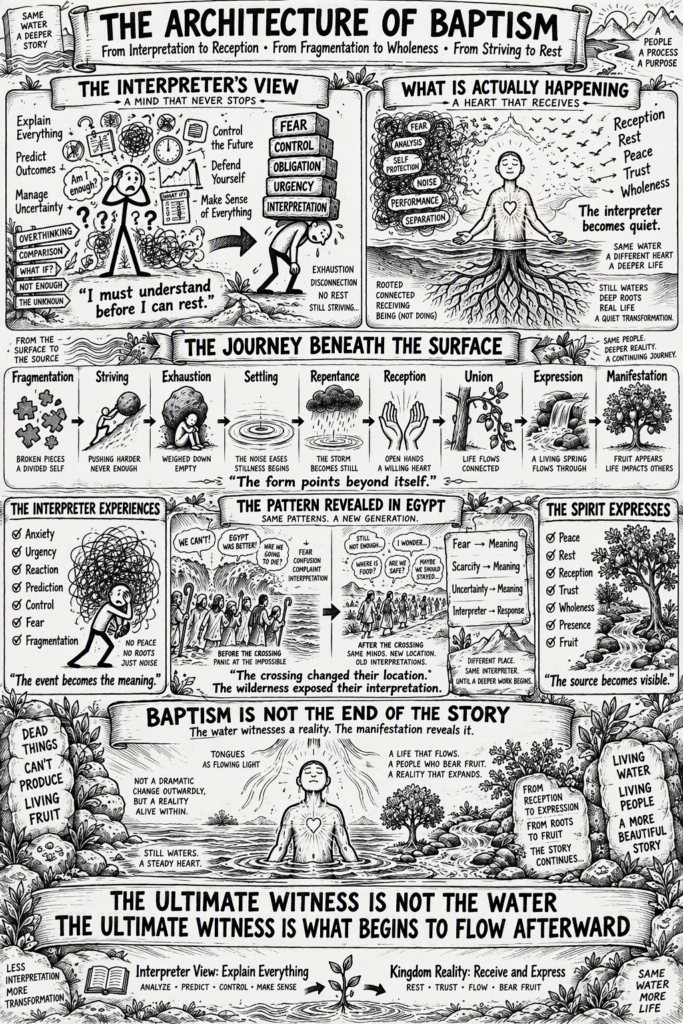
Most people assume they are responding to reality itself. In practice, most people are responding to the meaning they have assigned to reality. The event happens, and almost immediately the interpreter becomes active. It explains, predicts, judges, compares, defends, fears, and assigns meaning. Over time this activity becomes so normal that people mistake the interpreter for themselves.
This is why two people can experience the same situation and emerge with completely different experiences. The circumstance is the same. The interpretation is different. One finds peace. One finds fear. One finds opportunity. One finds threat. What is often shaping the experience is not the event itself, but the meaning-maker operating within it.
Scripture reveals that God does not merely give people new information. Information alone cannot free a person from the interpretive patterns through which they experience life. God reveals a pattern through which something deeper can occur.
Water baptism is part of that pattern.
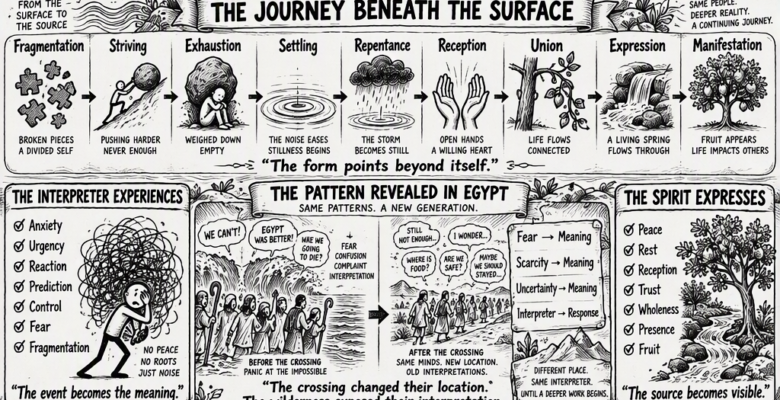
The purpose of baptism is not merely the performance of a religious act. Nor is it simply the observance of a doctrine. The form points beyond itself to something taking place that cannot be seen with natural eyes. The transition is not primarily occurring at the level of the body. It is occurring beneath conscious explanation, where perception, interpretation, and response are formed.
When the Interpreter Becomes Exhausting
There comes a point where a person becomes weary, not necessarily from circumstances, but from carrying the burden of interpretation.
- Every situation must be explained.
- Every uncertainty must be managed.
- Every outcome must be predicted.
- Every threat must be anticipated.
The mind remains occupied, continually attempting to create certainty through understanding. Eventually the effort becomes exhausting. Fear fragments. Control fragments. Self-preservation fragments.
The person becomes divided within themselves by the constant activity of trying to hold life together. This is where repentance begins.
Repentance is not primarily the production of effort. It is not the achievement of greater sincerity. It is not proving willingness. Repentance is the settling of the inner man. It is the quieting of the tensions, fears, conflicts, and interpretations that keep a person fragmenting themselves.
As the interpreter begins losing its dominance, something else becomes possible. The person becomes receptive. They begin to rest. Not because all of life’s circumstances have changed, but because the constant need to interpret, manage, and control begins to loosen.
The Name of Jesus Christ
The Name of Jesus Christ is often reduced to words spoken during baptism, yet the deeper reality is much greater than words.
The Name reveals source.
Jesus said He came in His Father’s Name. The Name was not merely something attached to Him. The Father was being revealed through Him. What was unseen became visible. What was hidden became expressed.
The same pattern appears here. The deeper reality is union. Not an agreement. Not a takeover. Not the achievement of a new religious identity. Union.
Something begins occurring that cannot be observed directly. No one can see peace emerging within the heart. No one can see fear losing its grip. No one can see the interpreter becoming quiet. Yet over time something begins expressing itself that was not previously being expressed.
A person may not even recognize when this begins. It may emerge during baptism, in prayer, while reading Scripture, during worship, while tarrying before God, or in moments that seem entirely ordinary and unplanned. At first there is no explanation, only expression. The movement of the Holy Ghost begins flowing before the interpreter can define it. The body responds before the mind can construct meaning around it. Words may emerge, tears may come, peace may settle, or tongues may begin to speak, not as the result of effort, but as the Spirit moves beyond the lifelong activity of the interpreter that has spent years analyzing, explaining, controlling, and assigning meaning to every experience. What is occurring cannot be fully understood in the moment because it is not originating from the meaning-maker. It is the manifestation of a different source beginning to find expression through the person.
Water Baptism: The Witness of Transition
When Paul writes, “Buried with him in baptism” and “We are buried with him by baptism into death,” it is easy to focus on the visible act while missing the reality being revealed through it.
The water itself is not changing the body. The body enters the water and emerges from the water much the same as before. The deeper transition cannot be seen through natural observation because it is occurring beneath the surface of conscious explanation.
- The form points beyond itself.
- The water witnesses a reality.
- The manifestation reveals it.
What matters is not merely what happens in the water, but what begins flowing afterward. Peace begins emerging where anxiety once dominated. Rest begins appearing where striving once governed. Expression begins moving ahead of explanation. Something begins flowing that could not have been manufactured through effort.
The witness is not merely that a person entered water and the witness is what begins expressing itself afterward.
The Pattern Revealed in Egypt
The Exodus reveals a much deeper pattern than simply leaving one place and arriving somewhere else.
Before Israel entered the Red Sea, a lamb was slain and the blood was applied. Then the waters opened before them and closed behind them. Once they crossed, they could not return the way they came. Yet even after crossing, their interpretation of reality remained largely unchanged.
In fact, the wilderness revealed just how active the interpreter, the carnal mind, remained even after the crossing. Their circumstances changed, but the source from which they interpreted those circumstances remained largely untouched.
I have watched this same pattern unfold in everyday life. Family and friends have left Detroit, Michigan and moved to Washington State, yet many struggled because the interpreter that had been shaped by one environment continued assigning meaning within an entirely different environment. The systems, relationships, expectations, and realities were different, but the lens through which they perceived those realities remained the same. Instead of adapting, they continued interpreting the new environment through the assumptions, fears, responses, and conclusions formed in the old one. Eventually, many returned to what felt familiar, not necessarily because it was better, but because it aligned with the interpreter they already knew.
The wilderness exposed this same principle. The greatest challenge was never simply where Israel was located. The challenge was that the interpreter within them continued producing meanings from the old source, even after they had physically crossed into something new.
Again and again, the issue was not the event. The issue was the interpretation of the event. Fear supplied meaning. Scarcity supplied meaning. Uncertainty supplied meaning.
The wilderness continually exposed the meaning-maker.
Even Moses was not exempt. Under pressure, the interpretation surrounding him eventually found expression through him. The issue was never merely behavior. The issue was perception. Interpretation. Source.
Walking in Newness of Life
The purpose of baptism is not simply forgiveness as it is commonly understood. When most people hear the word forgiveness, the mind immediately turns toward the past, searching for mistakes, failures, regrets, or things that must somehow be corrected. Yet the deeper reality is not about becoming occupied with what happened yesterday. It is about entering a state of rest now.
Forgiveness, in this sense, is not merely the removal of a debt. It is the settling of the inner man. It is the quieting of the tensions, fears, conflicts, and interpretations that keep a person fragmenting themselves. It is the movement from internal division toward wholeness, from striving toward rest, from constantly managing life toward simply receiving it.
When forgiveness is genuine, the child-pattern begins to reappear. A child can argue, cry, fight, and moments later be laughing and playing again because the experience does not become an identity, a burden, or a story that must be carried forward. The child returns naturally to the present. In much the same way, the need to continually defend, predict, control, explain, and hold everything together begins to loosen. Time loses its tyranny. Urgency loses its authority. Obligation no longer dominates perception. Peace begins appearing within circumstances that have not changed, and rest begins appearing within situations that previously would have produced anxiety. The person is no longer fragmenting themselves through constant interpretation, nor are they attempting to sustain themselves through effort. Instead, something deeper is gathering them back together, bringing the scattered parts into wholeness, and restoring the capacity to simply receive life as it unfolds.
As Paul wrote:
“For the law of the Spirit of life in Christ Jesus hath made me free from the law of sin and death.” (Romans 8:2)
The law of sin and death operates through continual cycles of interpretation, reaction, fear, striving, and self-preservation. The law of the Spirit of life introduces something entirely different. It is not improved interpretation. It is not better analysis. It is not heightened self-awareness. It is life emerging from a different source.
The evidence is not found primarily in a ceremony, an explanation, or even a testimony. The evidence is found in what begins to emerge. Peace appears where fear once governed. Rest appears where striving once ruled. Receptivity appears where self-protection once dominated. The life was always His. The source was always His. The expression simply becomes visible.
The Completion of the Pattern
Acts 2:38 reveals the pattern:
“Repent, and be baptized every one of you in the name of Jesus Christ for the remission of sins, and ye shall receive the gift of the Holy Ghost.”
Too often this is approached as a sequence of religious acts to be performed. The deeper reality being revealed is much more experiential. Repentance settles the inner man and quiets the activity of the interpreter. Baptism reveals a transition that cannot be seen with natural eyes. The Holy Ghost becomes the expression of what has been taking place beyond conscious explanation.
Taken together, the pattern reveals movement from fragmentation toward wholeness, from interpretation toward reception, from striving toward rest.
- The ultimate witness is not the water.
- The ultimate witness is not a person’s explanation of what happened.
- The ultimate witness is what begins to flow afterward.
The heart settles before it can explain itself. Peace appears before a person can define where it came from. The Spirit moves beyond the interpreter, and expression emerges before explanation. What was hidden gradually becomes visible, not through effort or performance, but through rest, peace, wholeness, and the manifestation of Christ through the person’s life.