
Bible Belt: Boundary Map
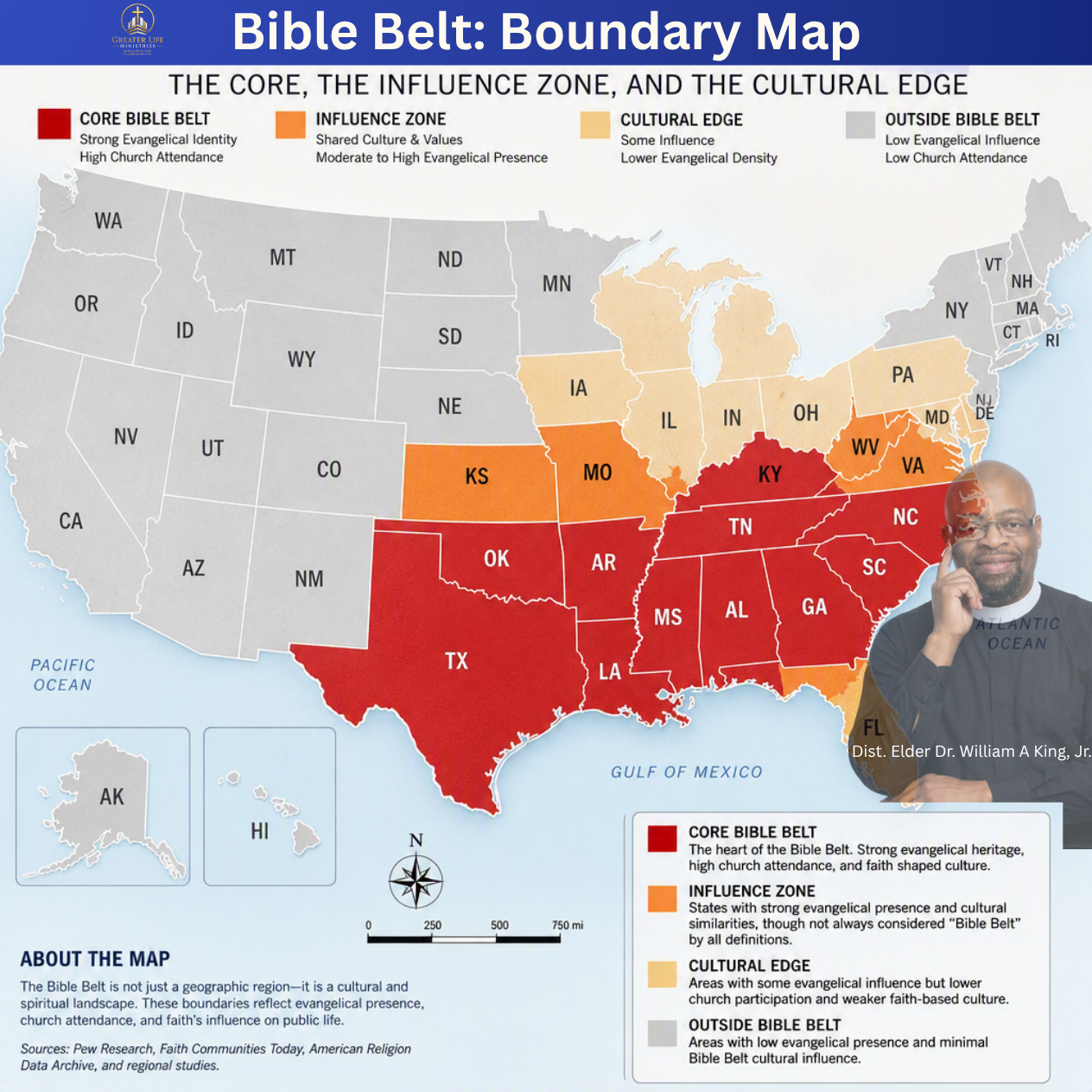
About The Map
The Bible belt is not just a geographic region; it is a cultural and spiritual landscape at the same time. These boundaries reflect evangelical presence, church, attendance, and faith influence on public life.
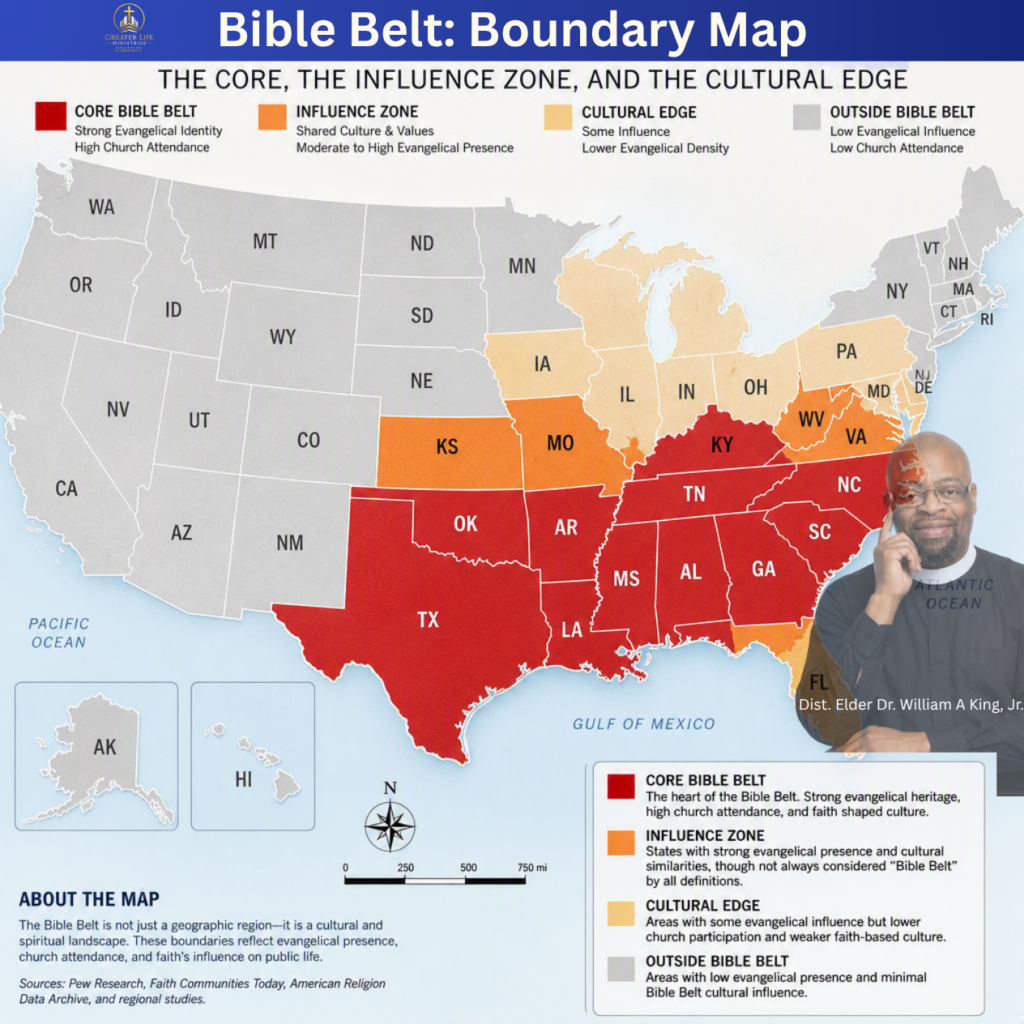
Map Legend
- Core Bible Belt: this is the heart of the belt with strong, evangelical heritage, high church attendance, and faith shaped cultures.
- Texas
- Oklahoma
- Arkansas
- Mississippi
- Alabama
- Louisiana
- Georgia
- Tennessee
- Kentucky
- South Carolina
- North Carolina
- Influence Zone: these are states with strong, evangelical presence and cultural similarities, though not always considered part of the belt by all definitions.
- Kansas
- Missouri
- West Virginia
- Virginia
- Northern Florida
- The Edge: these are areas with some evangelical influence, but lower church, participation, and weaker faith based culture than the southern states.
- Indiana
- Illinois
- Iowa
- Ohio
- Michigan
- Pennsylvania
- Maryland
- New Jersey
- District of Columbia
- Southern Florida
- Outside Zone: these are areas with low evangelical presence and minimal belt culture influence.
- Alaska
- Washington
- Oregon
- California
- Hawaii
- Idaho
- Nevada
- Arizona
- Utah
- Montana
- Wyoming
- Colorado
- New Mexico
- North Dakota
- South Dakota
- Nebraska
- Minnesota
- Wisconsin
- New York,
- Vermont,
- Massachusetts
- New Hampshire
- Maine
- Rhode Island
- Connecticut
- Delaware
Challenges
As we move through this workshop, it is important to understand that every ministry field comes with its own unique set of challenges. At the macro level, each region or zone has characteristics that affect how ministry occurs. At the micro level, those same challenges become even more pronounced within individual cities, neighborhoods, and communities.
For example, in Arizona, the climate itself can become a ministry challenge. During certain times of the year, temperatures can become so extreme that traditional door-to-door outreach becomes difficult. People are less likely to be outside, volunteers may struggle with the heat, and ministry methods that work well in one state may prove ineffective in another. The challenge is not a lack of passion. The challenge is adapting ministry strategies to the realities of the environment.
In the Pacific Northwest, the challenges are often very different. In cities such as Seattle, studies have consistently shown a large percentage of the population to be disconnected from organized religion. Many researchers point to factors such as high levels of education, strong individualism, diverse belief systems, and a culture that often values personal spirituality over institutional religious involvement. As a result, traditional approaches that may be effective in regions with strong church cultures often produce very different results in the Northwest.
This is one of the greatest mistakes ministries make when expanding into new regions. We assume that because a method worked somewhere else, it should work everywhere. We attempt to duplicate programs rather than understand people. We copy activities rather than studying culture.
The reality is that every mission field has a language, even when everyone speaks English. Every community has a worldview. Every neighborhood has its own history, fears, priorities, and experiences. Until we understand those realities, we are often speaking to people without truly connecting with them.
This is why I encourage ministers to become students of their community. Learn the rhythms of the city. Learn what concerns people. Learn what they celebrate. Learn what they fear. Learn what problems keep them awake at night. The more we understand the community, the more effectively we can communicate the gospel in ways that are meaningful and relevant.
Jesus demonstrated this principle throughout His ministry. He never changed the message, but He often changed the approach. To fishermen He spoke about nets, boats, and catches. To farmers He spoke about seed, soil, and harvest. To shepherds He spoke about sheep. He connected eternal truths to the lived experiences of the people standing in front of Him.
The lesson is simple. We do not change the gospel to fit the culture. We learn the culture so we can effectively communicate the gospel. The message remains the same, but the bridge that carries the message must often be built differently from one mission field to another.
The challenge, therefore, is not simply preaching the right message. The challenge is understanding the people we have been called to reach. When we take the time to understand the field, we position ourselves to minister with greater wisdom, greater compassion, and greater effectiveness. That understanding has become one of the foundational principles of West Coast Ministries and one of the most important lessons I learned after leaving the Bible Belt and serving in the Pacific Northwest.